Since mid-2025, at least a dozen senior U.S.-based executives have left major tech companies to launch new ventures as the rise of artificial intelligence creates a sweet spot for startup founders to transition.
Coforge announced on Friday that executive vice president Anup Kumar has resigned to pursue an “entrepreneurial path.”
These founders leverage years of customer contacts and knowledge of how large enterprises work to deliver cost-effective, AI-driven services. Experts say they know how to incorporate agent AI services to solve problems faster and cheaper than traditional IT companies.
“Senior leaders are leaving big tech companies because for the first time, small AI-native teams can win the kinds of jobs that once required armies of engineers,” said Gaurav Parab, principal industry analyst for IT services at consulting firm Nelson Hall. “Without the burden of legacy structures, companies can innovate faster, capture niche opportunities such as sub-industry use cases overlooked by larger companies, and scale through the networks they have built over decades.”
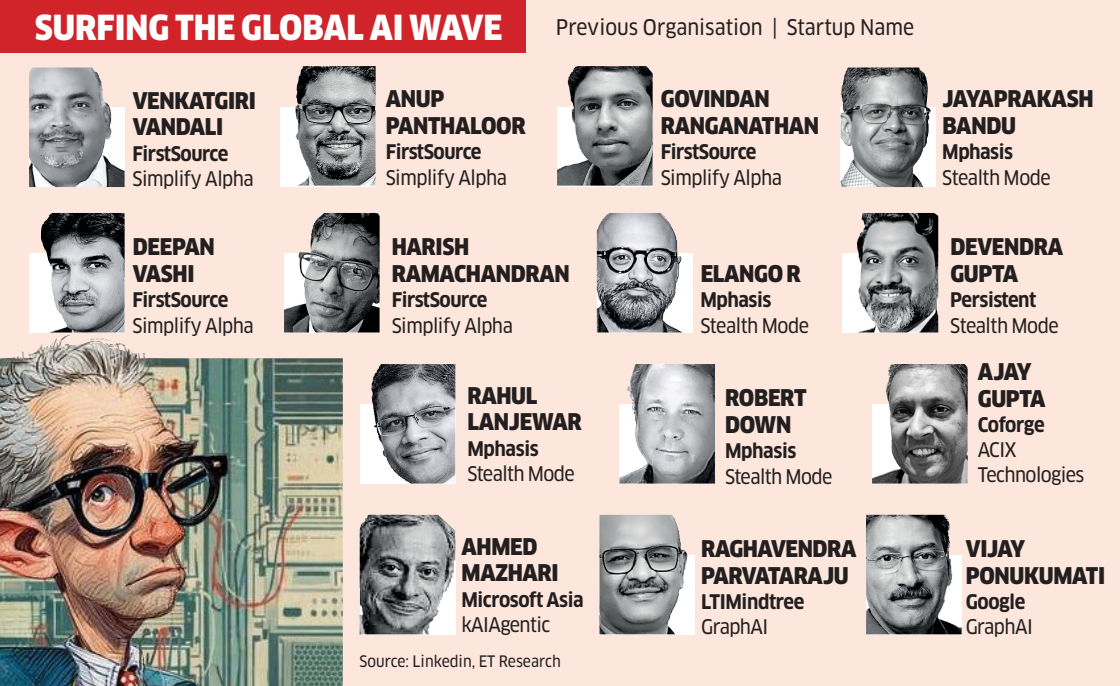
In one case, the entire senior leadership of business process outsourcing company FirstSource’s healthcare division left in February this year to launch Simplify Alpha, an ET investigation has revealed.
 Etech
EtechThey include Venkatiri Vandali, former President and Chief Sales Transformation Officer of Healthcare and Life Sciences at FirstSource; Deepan Vashi, Executive Vice President and Global Head of Solutions, Health Plans and Health Services; Anup Panthaloor, Vice President of Health Plans and Healthcare Services; Harish Ramachandran, SVP of Healthcare; and Govinandan Ranganathan, Vice President of Business Process Architecture as a Service.
“AI has negated the benefits of scale,” Vandari told ET. “Operating in silos of capabilities, geography, deal size, etc. is now a weakness rather than a strength. Everyone is chasing multi-billion dollar transformations, but the real unmet demand lies in the trenches. $2 million problems are too complex for junior teams and too small for global companies. We built Simplify Alpha to fill that very gap, and the client appetite there is insatiable.”
He said their new business has already partnered with a healthcare software provider and developed and acquired an implementation practice of 400 engineers.
“The catalyst was agent AI,” says Jayaprakash Bandhu. He recently left his senior leadership role at Mphasis to co-found an AI startup that is currently in stealth mode. “I spent 26 years in enterprise IT, and for the first time I saw a shift in technology where a small team could build something in a matter of weeks that previously took hundreds of engineers and years. That’s what inspired me to go out and start building.”
For IT services companies, this talent drain is a double whammy. Not only do they have to deal with the disruption of talent departures, but they also have to face new competition to learn how they work.
For example, for FirstSource, healthcare contributes more than 30% of its revenue.
Nelson Hall’s Parab expects this trend of senior executives turning to founders will accelerate.
Industry insiders say these founders are sought after by venture capitalists. Enterprise AI services are a popular investment area, and VCs want to back companies with proven client connections.
In its AI Services Report late last year, Bessemer Venture Partners said the best founding teams for AI-enabled services startups will have “deep expertise in selling, building, and delivering software in their subject area.”
The speed with which these executives are able to acquire clients is also critical to their investment thesis.
#Senior #executive #joins #party #startup #founder #Economic #Times